M-Pesa and API integrations for
Kenyan systems
Our M-Pesa and API integrations for Kenyan systems connect payment services, statutory portals, ERPs, SMS providers, and internal applications through APIs that are documented, observable, and designed around the data that must move.
API integration for
connected systems
Connecting a third-party service is part of a wider workflow. Our API integration services cover payment gateways such as M-Pesa and Stripe, logistics platforms, SMS providers, business systems, and the applications that rely on them.
We define an integration layer with clear contracts, retries where safe, diagnostic logs, callbacks, and reconciliation. That gives the team a way to understand what happened when an external provider is slow or unavailable.
Connect M-Pesa, cards, banks, or other providers around the payment journey your product needs.
Receive provider updates, record state changes, and notify the right parts of your application.
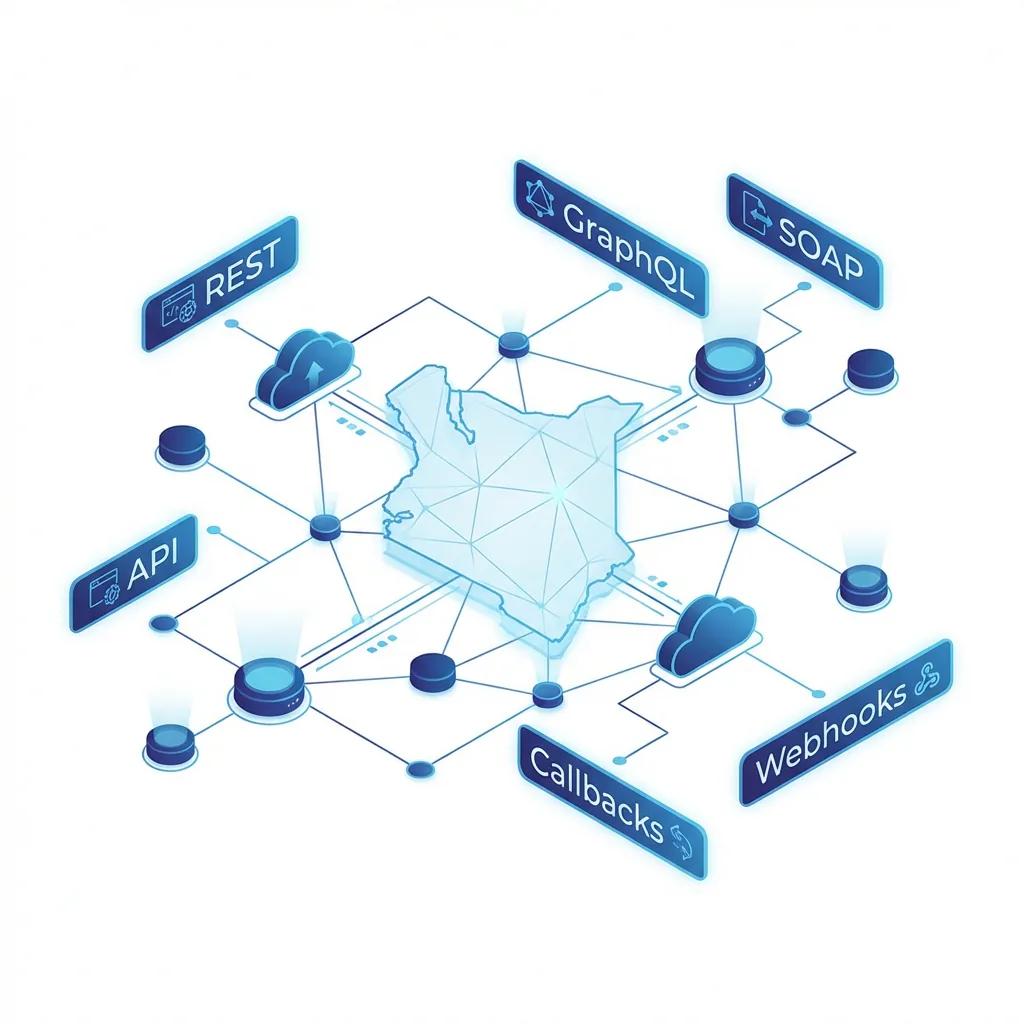
A dependable API layer
Each API defines what callers may send, what they receive back, and what happens when a request fails. That contract should be understandable to the developer and safe for the system behind it.
We provide backend API development in Kenya for mobile apps, web frontends, and services such as M-Pesa. The design may include idempotency, rate limits, authentication, queues, and reconciliation depending on the workflow.
-
Clear request and response contracts
-
Retry and failure handling
-
Documentation and support notes
{
  "status": "success",
  "data": {
    "transaction_id": "LGM1293K",
    "amount": 5000,
    "currency": "KES",
    "provider": "MPESA_EXPRESS",
    "timestamp": "provider response time",
    "webhooks": {
       "delivered": true,
       "status": "recorded"
    }
  }
}
Business system
integration
Organisations often need to connect older systems with newer applications. We assess what is already in place and add the smallest useful integration layer before recommending a larger replacement.
This can include connecting Oracle or SAP systems to web dashboards, synchronising an on-premise database with a hosted application, or moving records between services with clear ownership and error handling.
We review authentication, permissions, transport, secrets, logging, and data retention as part of the integration design. The controls depend on the systems and information involved.
Integration Workflow
Map users, records, interfaces, dependencies, and the outcome the integration must support.
Agree requests, responses, callbacks, error states, retries, and ownership.
Test normal and failure paths, then document release, support, and reconciliation steps.
APIs for the work at hand
The right endpoint depends on the workflow. We help teams connect the services they use and keep the request, response, callback, and support details understandable.
SMS API
Messaging integrations for alerts, one-time passwords, reminders, and other customer or internal notifications.
Connect to SMS APIAirtime API
Connect airtime distribution to the carriers and use case the product supports. Suitable for rewards, staff incentives, and other approved payment workflows.
Connect to Airtime APIM-Pesa Core
Support for C2B, B2C, and B2B flows, including STK Push, reversals, and balance queries. We account for callbacks, transaction states, and the reconciliation work around the payment.
Explore M-Pesa integrations Read the M-Pesa case study ->Documentation for the team
Good developer experience starts with clear documentation, examples, useful errors, and an agreed way to test integrations before release.
- ✓ Working examples where useful
- ✓ Test requests and responses
- ✓ Error and support notes
curl -X POST https://provider.example/v1/payment-request \
  -H "Authorization: Bearer {ACCESS_TOKEN}" \
  -H "Content-Type: application/json" \
  -d '{
    "phone": "+254700000000",
    "amount": 1000,
    "reference": "ORDER_123"
  }'
const response = await fetch(process.env.PROVIDER_URL, {
  method: 'POST',
  headers: { Authorization: `Bearer ${process.env.ACCESS_TOKEN}` },
  body: JSON.stringify({
  phone: '+254700000000',
  amount: 1000,
  reference: 'ORDER_123'
  })
});
use Illuminate\Support\Facades\Http;

$response = Http::withToken($accessToken)->post($providerUrl, [
    'phone' => '+254700000000',
    'amount' => 1000,
    'reference' => 'ORDER_123'
]);
Security in the integration
Access, data handling, and failure paths are considered as part of the API design.
Transport security
Secure connections selected for the environment
Authentication
Access designed around the clients and systems involved
Permissions and limits
Only the required systems and actions are exposed
Recovery planning
Backups, retries, and reconciliation where appropriate
Clarify the system boundaries before connecting them.
We define contracts, error handling, callbacks, retries, observability, and support ownership before integrations go live.
Payment providers, ERPs, CRMs, SMS services, government APIs, and the internal systems around them.
The payments, callbacks, updates, and records that cannot be lost or processed twice.
Late responses, duplicate callbacks, timeouts, reversals, and provider changes.
The person who sees an exception, checks a reconciliation, and decides what happens next.
Show us where the transaction can go wrong.
Before we talk architecture, show us the systems that need to communicate and what currently happens when a callback arrives late, twice, or not at all.
Need a Custom API?
Tell us which systems need to exchange information and what should happen when a request fails. We can help you define a sensible integration plan.